
Commercial Property Market Review – November 2026
| Despite tighter lending, industrial and City markets remain resilient, with occupier demand broadly stable | An increase in the Small Business Rates Relief thresholds is expected to benefit an additional 70,000 high street businesses | The government has launched a Strategic Sites Accelerator to speed up stalled commercial developments with strong investor interest |
Current commercial market conditions
The commercial market is facing tighter lending conditions, but some sectors are showing resilience.
This year has been shaped by economic uncertainty, so investors have turned to assets offering secure income, according to Allsop. In the industrial market, investment volumes reached £1.26bn in quarter two, marking a 13% quarterly increase, with distribution assets attracting strong investor interest. In the City market, investment volumes were at £1.21bn in quarter three, bringing the year-to-date total to £3.085bn, up 25% on the previous year. Demand remains high for ‘well-located, best-in-class office buildings with strong ESG and sustainability.’
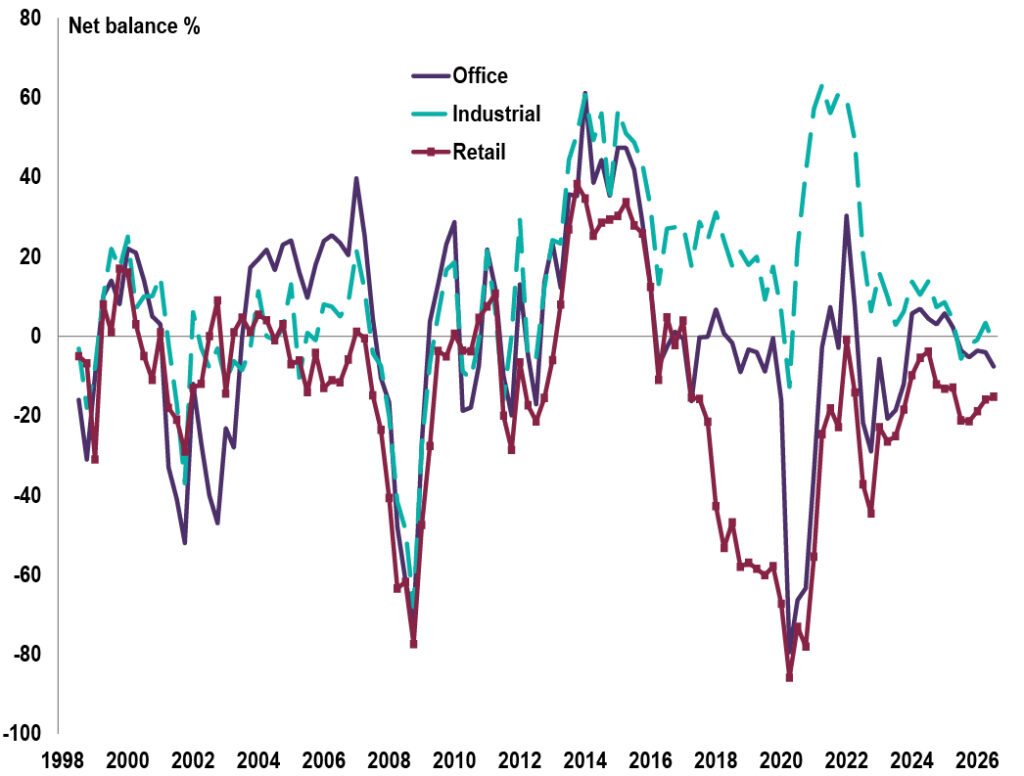
The latest survey from the Royal Institution of Chartered Surveyors (RICS) shows that rising gilt yields have affected investment sentiment, with the credit conditions indicator falling from a net balance of -23% in Q2 to -37% in Q3. However, occupier demand remains broadly stable, and respondents still expect rental growth for prime offices in the coming year.
The impact of the Budget
In the Budget, Chancellor John Healey announced measures that will affect specific areas of the commercial property market.
The Small Business Rates Relief thresholds will increase from a rateable value of £12,000 to £18,000 for full relief, and £15,000 to £21,000 for tapered relief, which is expected to benefit an additional 70,000 regional high street businesses. As part of the roadmap to fiscal devolution, mayors will receive a 20% share of locally retained business rates from April 2027, with local authorities set to retain 100% by the end of the decade. Knight Frank notes that ‘giving mayors and councils a clearer financial stake in business-rate growth should strengthen the incentive to support commercial development and reinvest in enabling infrastructure.’
It is expected that the changes could help reduce the number of empty shops, particularly on smaller high streets outside major cities, by making retail spaces more affordable.
Smaller property owners, especially those with properties valued at under £18,000 for business rates purposes, could also benefit from increased interest from potential tenants and a stronger pool of businesses looking to rent.
Government to accelerate stalled developments
The government has launched a Strategic Sites Accelerator (SSA) to help bring forward stalled commercial developments with strong investor interest.
The pilot scheme is backed by over £700m in public capital and will invest in six to 10 sites over the course of this Parliament. The fund will be complemented by technical advisory support and could potentially bring forward other early-stage projects to an investment-ready state.
Mayors and local authorities will help to identify suitable pipeline projects for the programme, which aims to attract up to £2bn in private investment. The government is already in talks about bringing forward the Science and Technology Park in Burgess Hill and Don Valley Corridor’s Runway Park in South Yorkshire.
Chancellor John Healey said, “This £700m package is helping break down the barriers to local growth, so people can feel the benefits of a growing economy and love where they live.”
Commercial Property Outlook
Occupier demand – broken down by sector
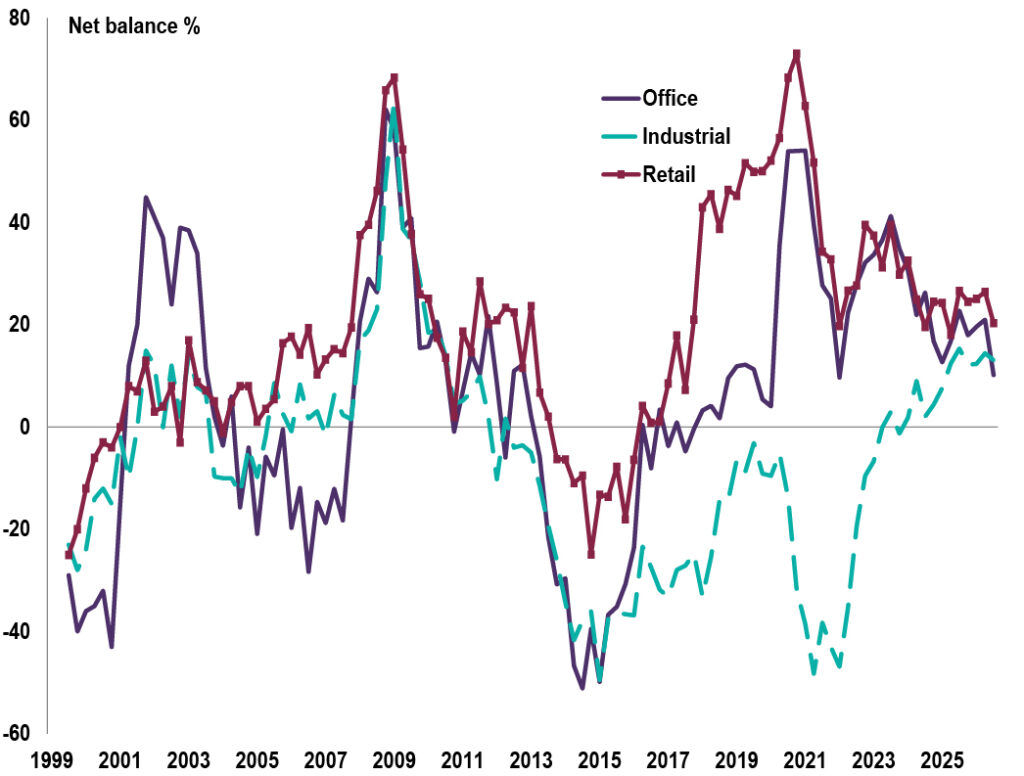
Availability – broken down by sector
Higher defence spending to boost industrial and logistics sector
The UK government has committed to increasing its defence spending to 2.7% of Gross Domestic Product (GDP) from 2027 – 2028 onwards.
The ongoing global conflicts have prompted a shift in priorities for several countries, with many Baltic and Eastern European nations committing to spending over 4% of GDP on defence. Meanwhile, NATO has set a target of 3.5% of GDP by 2035.
Savills predicts that additional spending will drive strong growth in industrial and logistics infrastructure due to increased demand for specialised facilities, such as logistics hubs and high-power data centres. In turn, this will create more jobs – the Strategic Defence Review expects that, if the UK increases its spending to 3.5% of GDP, it could create an additional 45,160 manufacturing jobs and 16,970 logistics jobs. Under this scenario, logistics demand could grow by 92,000 sq. m annually over eight years, reaching 190,000 sq. m.
It is important to take professional advice before making any decision relating to your personal finances. Information within this document is based on our current understanding and can be subject to change without notice and the accuracy and completeness of the information cannot be guaranteed. It does not provide individual tailored investment advice and is for guidance only. Some rules may vary in different parts of the UK. We cannot assume legal liability for any errors or omissions it might contain. Levels and bases of, and reliefs from taxation are those currently applying or proposed and are subject to change; their value depends on the individual circumstances of the investor. No part of this document may be reproduced in any manner without prior permission.
(All details are correct at the time of writing 18/11/26)