
Residential Property Review – July 2026
| Housing outlook – the latest data suggests that deteriorating market conditions may be easing slightly | House sales – the government has announced plans aim to stop last-minute outbidding in England and Wales | House purchases – recent data from eXp UK indicates homebuyer demand in England dipped in Q2 |
The latest RICS Market Survey
The latest Residential Market Survey from the Royal Institution of Chartered Surveyors (RICS) suggests that the deteriorating market conditions may be easing slightly.
Tarrant Parsons, Head of Market Research and Analysis at RICS, observed, “June’s survey results offer some cautious encouragement that the worst of the slowdown in market activity may be beginning to pass, with several key indicators moving in a less negative direction for a second consecutive month.”
New buyer enquiries posted a net balance of -29%, up from -34% in the previous two months and the highest reading since February. Meanwhile, near-term sales expectations showed some improvement, rising to -16%. Over the next twelve months, sales volumes are expected to remain broadly flat, with a net balance of +1%.
In the lettings market, tenant demand showed signs of improvement as it rose to +16%, the strongest reading since May 2025, but landlord instructions remained in negative territory at -18%.
Plans to end ‘gazumping’
The government has announced plans to end ‘gazumping,’ meaning buyers in England and Wales will no longer be at risk of being outbid at the last minute, potentially causing a sale to fall through.
Currently, buyers and sellers can walk away after an offer has been accepted, which can disrupt the sale chain and incur unwanted costs for the other party. However, there are plans to follow in the footsteps of Scotland and make sales agreements legally binding at an earlier stage. This will stop a buyer from being ‘gazumped’ unless there is a legitimate reason. It is hoped that these changes, which are expected to be introduced in 2029, will speed up the homebuying process. As well as this, sellers and estate agents will be required to share more information upfront. Overall, the government estimates that the reforms should save the average buyer £650.
Homebuyer demand slips
Recent data from eXp UK indicates that homebuyer demand in England dipped in Q2, as the proportion of properties under offer fell to 41.2%.
The statistics highlight that the regional divide persists, with performance varying significantly depending on the area. East Riding of Yorkshire saw the strongest increase in buyer demand, with a quarterly rise of 3.1%. Although the City of London is the most expensive area in which to buy, demand still increased by 0.7% in Q2. Meanwhile, Dorset, Surrey and Bristol saw the sharpest drops in homebuyer demand. This coincides with new data from Connells showing there has been a 6% decline in the number of homes for sale that have secured an offer this year.
Adam Day, Head of eXp UK and Europe, commented, “What continues to stand out is the resilience being shown by many markets across the North and Midlands, where affordability remains comparatively stronger and buyer activity has generally held up better.”
House prices headline statistics
- Average house prices in the UK increased by 2.7%in the year to May 2026
- House prices increased by0.3%on average between April 2026 and May 2026
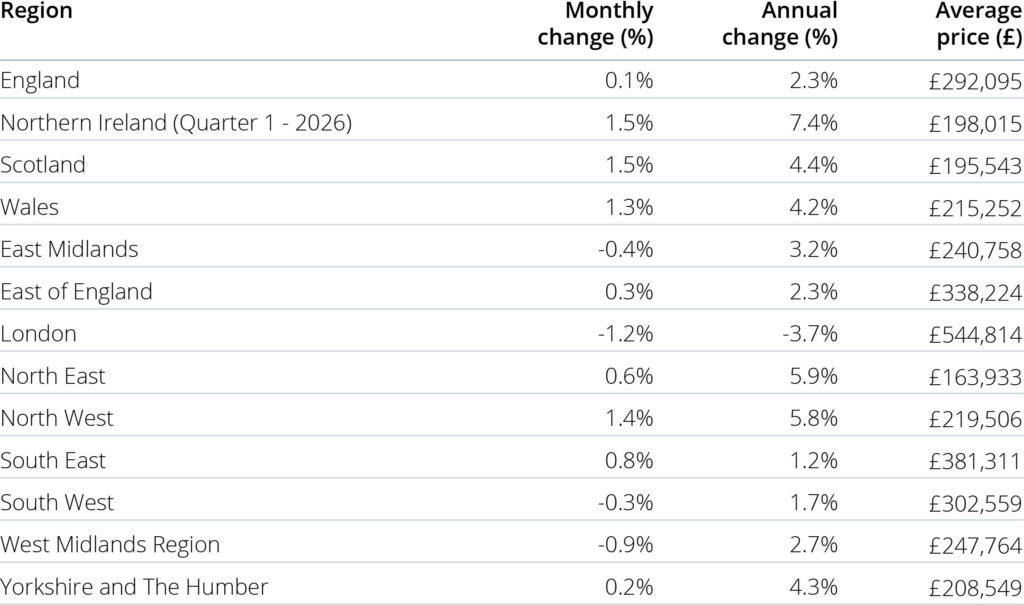
- The average house price in London was £544,814.
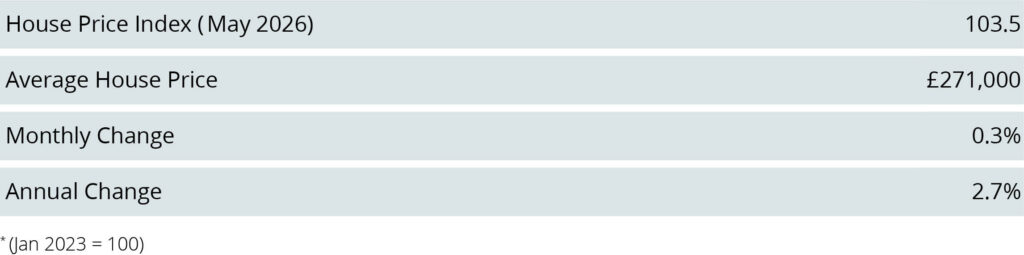
House prices – Price change by region
Average monthly price by property type – May 2026

New Prime Minister:
“We look forward to working constructively with Prime Minister Andy Burnham’s government, bringing our standards, data and professional expertise to support practical reform across housing, infrastructure and the built and natural environment. A clear opportunity to make a practical difference to people’s lives is to improve the way homes are bought and sold.”
Justin Young, Chief Executive, RICS
All details are correct at the time of writing (22 July 2026)
It is important to take professional advice before making any decision relating to your personal finances. Information within this document is based on our current understanding and can be subject to change without notice and the accuracy and completeness of the information cannot be guaranteed. It does not provide individual tailored investment advice and is for guidance only. Some rules may vary in different parts of the UK. We cannot assume legal liability for any errors or omissions it might contain. Levels and bases of, and reliefs from taxation are those currently applying or proposed and are subject to change; their value depends on the individual circumstances of the investor. No part of this document may be reproduced in any manner without prior permission.