
Commercial Property Review – July 2026
| Commercial market – as more organisations implement return-to-office mandates, office attendance levels increase | Commercial assets – according to NAEA, investors may be shifting focus from residential to commercial assets | Infrastructure – in the coming years attention will shift to improving existing buildings rather than developing new ones |
Office occupier market update
The latest Commercial Market Outlook from Carter Jonas has highlighted the current trends in the office occupier market.
More organisations are implementing return-to-office mandates, which have caused office attendance levels to increase. More businesses are looking for high-quality space to make office working more appealing for those who have become accustomed to working from home since the pandemic. Buildings that are sustainable and energy-efficient are particularly popular as they have reduced occupational costs and can help businesses meet their ESG goals. Also, from 2031 the government plans to introduce a minimum EPC rating of B for larger non-domestic properties.
There continues to be a shortage of prime supply in key city centre markets, partly because office development has been limited since 2020. This issue extends to the core City of London, which is low on quality floor space despite being more able to accommodate large-scale high-rise schemes.
Investors shift focus to commercial assets
According to NAEA Commercial Propertymark’s Advisory Panel, investors may be shifting their focus from residential to commercial assets in response to changing tax rules.
In recent years, there have been changes to the rules and regulations of the private rental sector, affecting residential landlords. As a result, panel members reported that some investors are turning to commercial property as the legislative framework is considered to be less restrictive. Despite commercial property typically having higher entry costs and more complex transactions, agents have noted a rise in enquiries from investors looking to move away from the residential market.
Steve Lane, a member of the Advisory Panel, noted that more investors are seeking professional advice if they are considering the switch.He explained, “Many of these investors need guidance on the differences between the tax and regulatory structures of the two markets. This includes borrowing ratios, tax liabilities, and regulatory obligations.”
Retrofitting likely to rise
Retrofitting is likely to become a key topic of conversation in the coming years as the focus shifts to improving existing buildings rather than developing new ones.
Savills notes that most of the buildings that will exist in 2050 are already standing. With the UK committed to reaching net zero by this time, the attention will necessarily shift to retrofitting. In the offices and retail sector, retrofitting is largely connected to an aim to achieve EPC ratings of A and B, with a view to all buildings becoming fully electric. In this area, investors are increasingly prioritising assets that will protect their income, maintain liquidity and support leasing. Meanwhile, in the industrial and logistics sector, retrofitting is generally motivated by meeting occupier needs and complying with regulations. Operational performance is also a key factor, with many projects aiming to minimise disruption by aligning improvements with lease events and planned refurbishments.
Commercial Property Outlook
Capital value expectations – broken down by sector
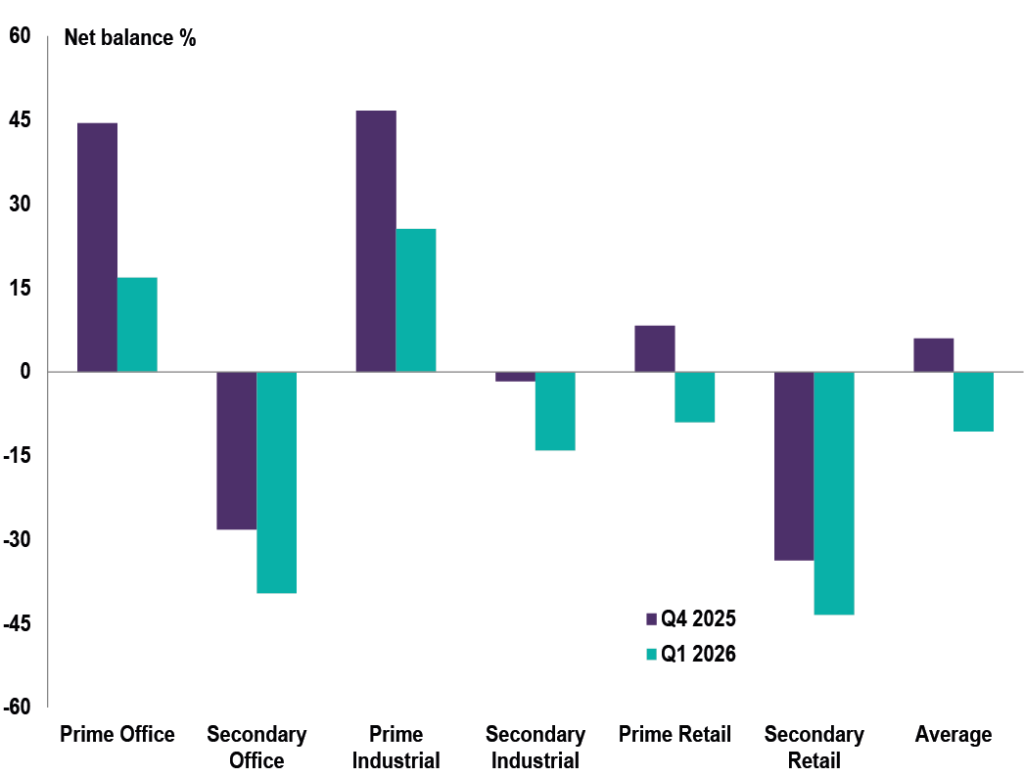
- Credit conditions indicator turns sharply negative, with capital value expectations downgraded amid renewed inflationary pressures
- The all‑property net balance for twelve‑month capital value expectations came in at ‑18%
- Prime office capital values are now projected to rise by 0.7% over the coming year (down from 1.9% in Q4).
Rent expectations – broken down by sector
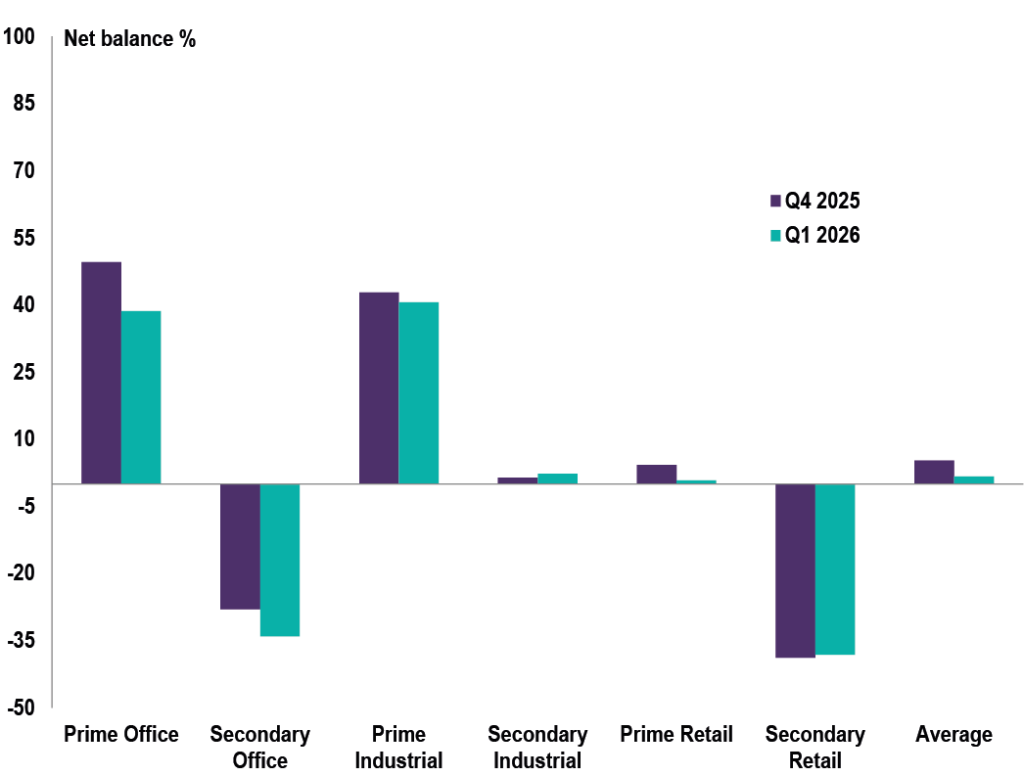
- Twelve-month rental growth projections for prime office and industrial sectors remain in positive territory, though modestly scaled back
- Prime office rents are now anticipated to grow by 2% over the coming year (down slightly from 2.5% during Q4)
- Prime retail rents are now expected to edge very slightly lower over the next twelve months, at -0.5%.
Healthcare sector shows resilience
According to Knight Frank, UK healthcare real estate transactions reached £11.3bn in 2025, the highest level since 2012 and approximately four and a half times the five-year average.
The market was boosted by a surge in large platform acquisitions and portfolio transactions, with portfolio deals accounting for 89% of all activity across the year. Elderly care assets were investors’ primary focus, representing 80% of total transaction volume. There was also a notable rise in overseas investment, with international capital accounting for 74% of transaction volume. At the end of 2025, average annualised returns hit 7.7% – this is up from 5.8% the previous year, which shows that the healthcare sector continues to be a strong option for long-term investment.
Julian Evans at Knight Frank commented, “2025 was a landmark year for healthcare real estate investment, driven by a combination of demographic fundamentals, strong operator performance and growing institutional interest in the sector.”
All details are correct at the time of writing (22 July 2026)
It is important to take professional advice before making any decision relating to your personal finances. Information within this document is based on our current understanding and can be subject to change without notice and the accuracy and completeness of the information cannot be guaranteed. It does not provide individual tailored investment advice and is for guidance only. Some rules may vary in different parts of the UK. We cannot assume legal liability for any errors or omissions it might contain. Levels and bases of, and reliefs from taxation are those currently applying or proposed and are subject to change; their value depends on the individual circumstances of the investor. No part of this document may be reproduced in any manner without prior permission.