
Commercial Property Review – February 2026
| High demand for office space – research shows office space is currently the most in-demand commercial property asset class | London offices update – office take-up in the capital marks London’s strongest performance since 2019 | The (in)efficiency of commercial buildings – analysis indicates 81% of UK city commercial buildings have a low EPC rating |
High demand for office spaces
Recent data shows that office space is attracting the highest level of investor interest in England.
Research from BPS London shows that office space is currently the most in-demand commercial property asset class, with 30.5% of office opportunities either under offer or sold subject to contract. This indicates that businesses are shifting back to office-based working after the pandemic. Retail spaces are a close second with 30.2% of opportunities under offer, followed by industrial and warehouse opportunities at 27.5%. Meanwhile, investor demand is much weaker in the leisure and hospitality sectors, with only 16.1% of opportunities attracting an investor.
Investors are showing particularly strong interest in office spaces in the West Midlands (39.0%) and the South East (36.6%). London offices are attracting lower levels of interest (21.6%) – this is likely due to oversupply, with offices representing 71.0% of all available commercial rental stock in the capital.
London offices update
Research from Knight Frank offers an insight into the current state of the London office market.
Office take-up in the capital reached 12.1 million sq. ft across 1,400 deals in 2025, marking London’s strongest performance since 2019. This was partly driven by a notable rise in demand for larger spaces, with around 70% of major corporate lettings in Central London expanding their office footprint last year.
However, supply of prime space is limited; vacancy rates for new, high-spec offices in the City Core are now at 0.3%. Competition is likely to intensify in the coming years, as up to 50 million sq. ft of London office leases are due to expire between now and 2030. Philip Hobley at Knight Frank commented, “London’s business sector’s growth urgently requires new supply to be unlocked in all of its key submarkets in order to meet structural demand over the next five years.”
The (in)efficiency of commercial buildings
Analysis by the British Property Federation (BPF) shows that 81% of commercial buildings in major UK cities have an EPC rating below B.
The research analysed commercial buildings across all asset classes in London, Birmingham, Bristol, Leeds, Liverpool, Manchester and Newcastle. It found that only 3% of buildings have an EPC rating of A, while 16% are rated B. Manchester has the most energy-efficient buildings, with 22% of commercial properties rated A or B. London follows closely at 21%.
In 2021, the government launched a consultation into minimum energy efficiency standards for non-domestic buildings. It proposed a target of EPC C by 2027 and EPC B by 2030, however these measures are yet to be officially implemented. Rob Wall, Assistant Director at BPF, urged the government to take action, saying “Clarity on future standards is critical to increasing demand, attracting investment and building green skills and supply chains.”
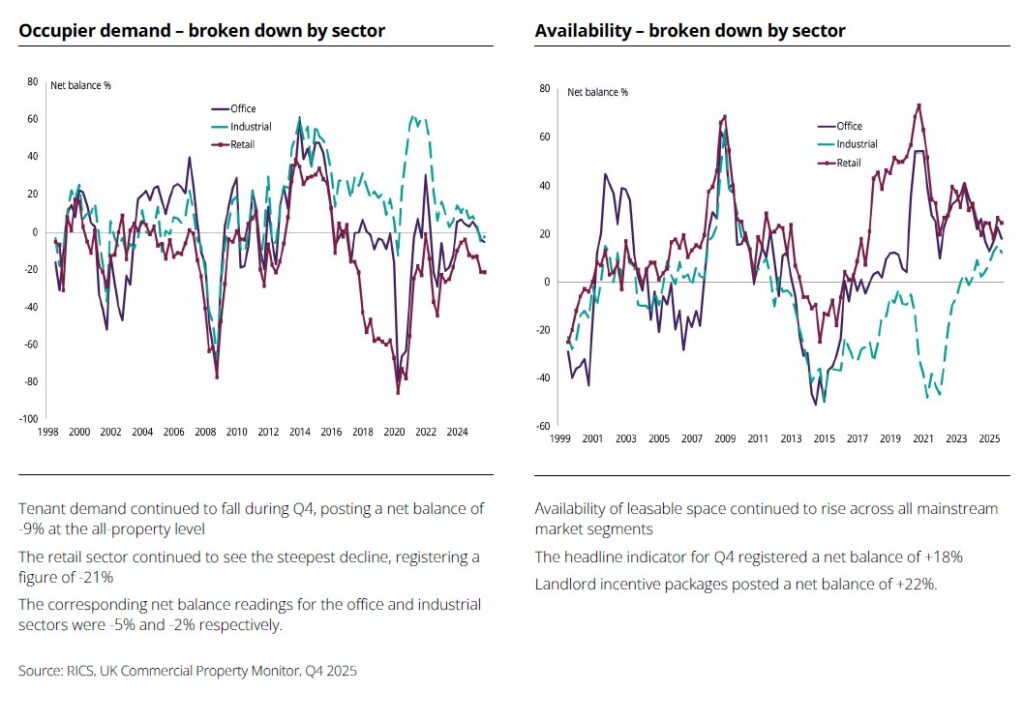
Scottish market temperature check
The latest commercial property survey from the Royal Institution of Chartered Surveyors (RICS) suggests that Scottish respondents are cautiously optimistic about the year ahead.
In Q4 2025, a net balance of 12% of respondents reported an increase in occupier demand for Scottish commercial property. Performance varied across subsectors; a net balance of 39% reported a rise in demand for the industrial sector, while -12% noted a drop in demand for retail space.
The outlook for capital values is generally positive, with a net balance of 9% expecting to see a rise at an all-sector level over the next three months. This increases to 21% when considering expectations for capital values over the next 12 months. In terms of rent, a net balance of 18% of Scottish respondents anticipate a rise in Q1 2026.
Tarrant Parsons at RICS commented on the findings, “The Q4 results suggest the UK commercial property market is beginning to find its footing after a prolonged period of adjustment.”